Google Track

Showing posts with label machine. Show all posts

Friday, June 20, 2014

Must read before attending any data science interview

Vincent GranvilleHere is fundamental resources that you should check out before your next data science interview. Read these documents thoroughly to get prepared, impress your interviewer, boost your chances to be hired, and get a bigger paycheck if hired:

Resources to read 2-3 days before your job interview:
Related articles

Friday, January 24, 2014

Big Data and Data Science Books - A Baker's Dozen

Here are 13 informative and inspirational books on Big Data and Data Science.  This is definitely not intended to be a comprehensive list (since a complete list of such readings would itself be a form of "Big Data", and consequently the number of possibilities is a nearly uncountable number!NOTE definition of "uncountable" = an infinite set that contains too many elements to be countable.)
  1. Big Data: A Revolution That Will Transform How We Live, Work, and T..., by Viktor Mayer-Schonberger and Kenneth Cukier
  2. The Signal and the Noise: Why So Many Predictions Fail-but Some Don't, by Nate Silver
  3. Predictive Analytics: The Power to Predict Who Will Click, Buy, Lie..., by Eric Siegel 
  4. The Human Face of Big Data, by Rick Smolan and Jennifer Erwitt
  5. The Black Swan: The Impact of the Highly Improbable, by Nassim Nicholas Taleb
  6. Competing on Analytics: The New Science of Winning, by Thomas H. Davenport and Jeanne G. Harris
  7. Super Crunchers: Why Thinking-by-Numbers is the New Way to Be Smart, by Ian Ayres
  8. Big Data Marketing: Engage Your Customers More Effectively and Driv..., by Lisa Arthur
  9. Journeys to Data Mining: Experiences from 15 Renowned Researchers, by Mohamed Medhat Gaber (editor)
  10. The Fourth Paradigm: Data-Intensive Scientific Discovery, by T.Hey, S.Tansley, and K.Tolle (editors)
  11. Seven Databases in Seven Weeks: A Guide to Modern Databases and the..., by Eric Redmond and Jim Wilson
  12. Data Mining And Predictive Analysis: Intelligence Gathering And Cri..., by Colleen McCue
And here are two more, as a bonus:
 14. A Statistical Guide for the Ethically Perplexed, by Lawrence Hubert and Howard Wainer

Friday, December 13, 2013

Are You Recruiting A Data Scientist, Or Unicorn?

Guest blog by Jeff Bertolucci (InformationWeek)
Many companies need to stop looking for a unicorn and start building a data science team, says CEO of data applications firm Lattice.
The emergence of big data as an insight-generating (and potentially revenue-generating) engine for enterprises has many management teams asking: Do we need an in-house data scientist?
According to Shashi Upadhyay, CEO of Lattice, a big data applications provider, it doesn't make sense for organizations to hire a single data scientist, for a variety of reasons. If your budget can swing it, a data science team is the way to go. If not, data science apps may be the next best thing. "If you look at any industry, the top 10 companies can afford to have data scientists, and they should build data science teams," Upadhyay told InformationWeek in a phone interview.
But the solution is less clear for smaller organizations. "The pattern that I've seen now, having done this for over six years, is that very often medium-sized companies think of the problem as, 'I need to go and get me one data scientist,'" said Upadhyay.
[Guidelines aim to combat potential misuse of big data. Read Data Scientists Create Code Of Professional Conduct.]
But the shortage of data scientists, a problem that's only expected to worsenin the next few years, makes that approach a risky proposition.
For example, a company may hire one or two people, Upadhyay said, "but before you know it, because the supply for this talent group is so far behind demand, they have lost this person [who] has gone to the next company. And all of a sudden, all that good work is lost. And you ask yourself, 'Why did that happen? And how can I manage against it?'"
One common problem, he noted, is that companies simply don't understand data scientists and how they work. The job generally requires knowledge of a wide array of technical disciplines, including analytics, computer science, modeling, and statistics. "They also tend to be fairly conversant in business issues," Upadhyay added.
But it's often difficult to find these divergent skills in a single human being. "It's a little bit like looking for a unicorn," Upadhyay said.
When medium-sized companies -- those that fall below the top five in a given industry, for instance -- hire just one or two data scientists, they often can't provide a long-term career path for those people within the company. As a result, the data scientists get frustrated and move onto the next thing.
In Silicon Valley, where data scientists command six-figure salaries and are in great demand, it's very difficult to retain talented people.
The better solution? Build a team.
"You will absolutely get a benefit if you hire a data science team," said Upadhyay. "Go all the way [and] commit to creating a creating a career path for them. And if you do it that way, you will get the right kind of talent because people will want to work for you."
Smaller companies that can't afford data science teams should consider big data applications instead. The biggest firms -- in Upadhyay's words, "the Dells, HPs, and Microsofts of the world" -- can take both approaches: data science teams and big data apps.
The team approach seems to be winning. "I rarely see teams that are one or two people in size," Upadhyay observed. "Obviously people have those teams, but they tend to evaporate over time. Until they get to a team of 10 people or more, [companies] can't justify it."
So what does a data science team cost, and what's the payoff?
Upadhyay offered this example: Say you hire a team of 10 data scientists with an average annual cost of $150,000 per employee. "That's $1.5 million for a data science team," he said. "So they better be creating at least $15 million dollars in value for you -- 10 times [the expense] -- to be worth it."
Emerging software tools now make analytics feasible -- and cost-effective -- for most companies. Also in the Brave The Big Data Wave issue of InformationWeek: Have doubts about NoSQL consistency? Meet Kyle Kingsbury's Call Me Maybe project. (Free registration required.)

Wednesday, July 17, 2013

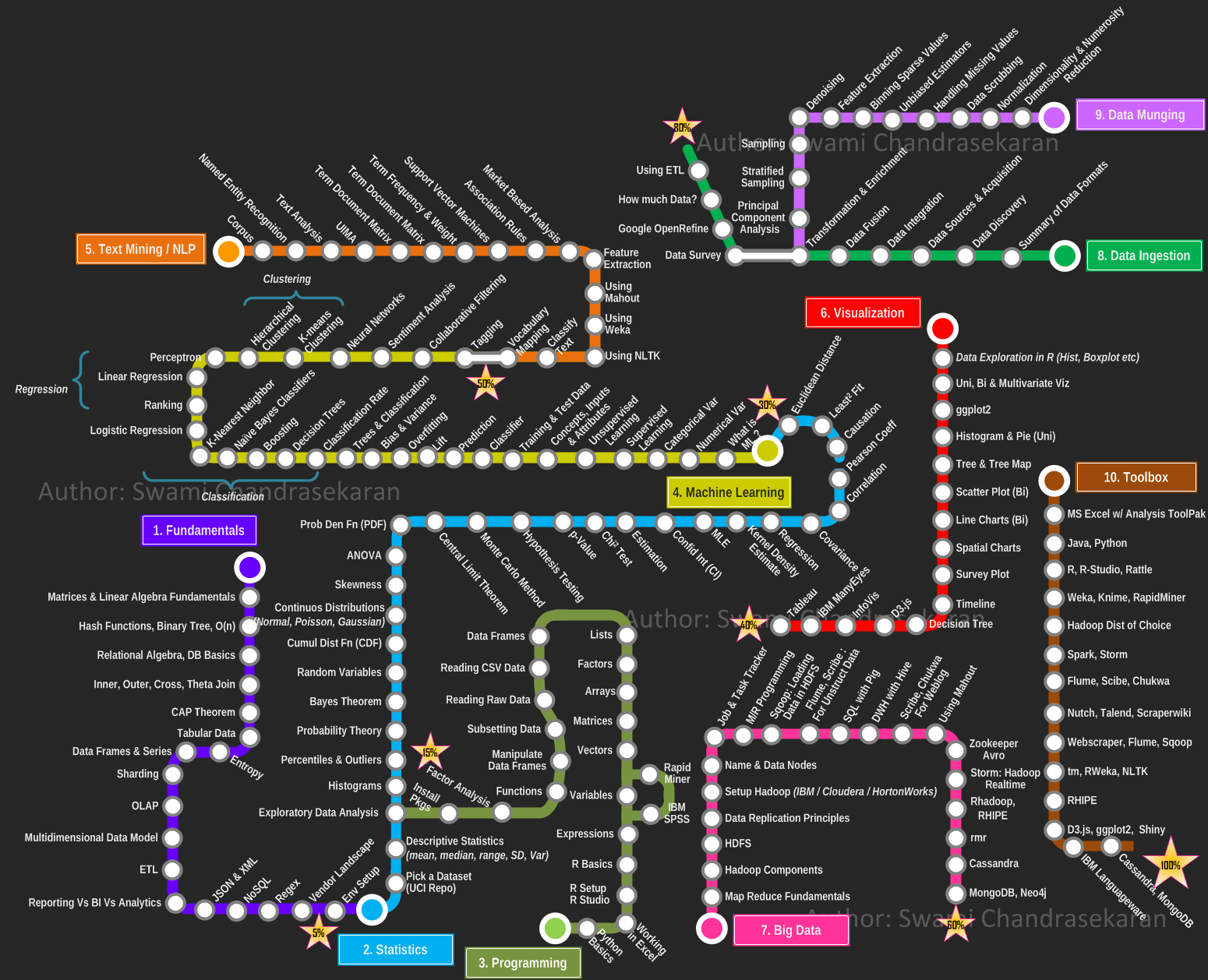
Becoming a Data Scientist – Curriculum via Metromap

by Swami Chandrasekaran

Data Science, Machine Learning, Big Data Analytics, Cognitive Computing .... well all of us have been avalanched with articles, skills demand info graph's and point of views on these topics (yawn!). One thing is for sure; you cannot become a data scientist overnight. Its a journey, for sure a challenging one. But how do you go about becoming one? Where to start? When do you start seeing light at the end of the tunnel? What is the learning roadmap? What tools and techniques do I need to know? How will you know when you have achieved your goal?
Given how critical visualization is for data science, ironically I was not able to find (except for a few), pragmatic and yet visual representation of what it takes to become a data scientist. So here is my modest attempt at creating a curriculum, a learning plan that one can use in this becoming a data scientist journey. I took inspiration from the metro maps and used it to depict the learning path. I organized the overall plan progressively into the following areas / domains,
  1. Fundamentals
  2. Statistics
  3. Programming
  4. Machine Learning
  5. Text Mining / Natural Language Processing
  6. Data Visualization
  7. Big Data
  8. Data Ingestion
  9. Data Munging
  10. Toolbox
Each area  / domain is represented as a "metro line", with the stations depicting the topics you must learn / master / understand in a progressive fashion. The idea is you pick a line, catch a train and go thru all the stations (topics) till you reach the final destination (or) switch to the next line. I have progressively marked each station (line) 1 thru 10 to indicate the order in which you travel. You can use this as an individual learning plan to identify the areas you most want to develop and the acquire skills. By no means this is the end; but a solid start. Feel free to leave your comments and constructive feedback.
PS: I did not want to impose the use of any commercial tools in this plan. I have based this plan on tools/libraries available as open source for the most part. If you have access to a commercial software such as IBM SPSS or SAS Enterprise Miner, by all means go for it. The plan still holds good.
PS: I originally wanted to create an interactive visualization using D3.js or InfoVis. But wanted to get this out quickly. Maybe I will do an interactive map in the next iteration.